


Series: Resonance Frequency breathing, Letter 2 of 4.
Last week I took resonance frequency breathing apart and showed you the chemistry underneath it. The carbon dioxide, the diaphragm, why low and slow beats fast and high. It was a letter about mechanism.
This week I want to show you that same mechanism happening, live, on a screen. You can understand exactly how something works and still not quite feel it’s true about your own body until you watch it move.
I’ve included a video further down, of exactly what I’m talking about.
The moment it clicks
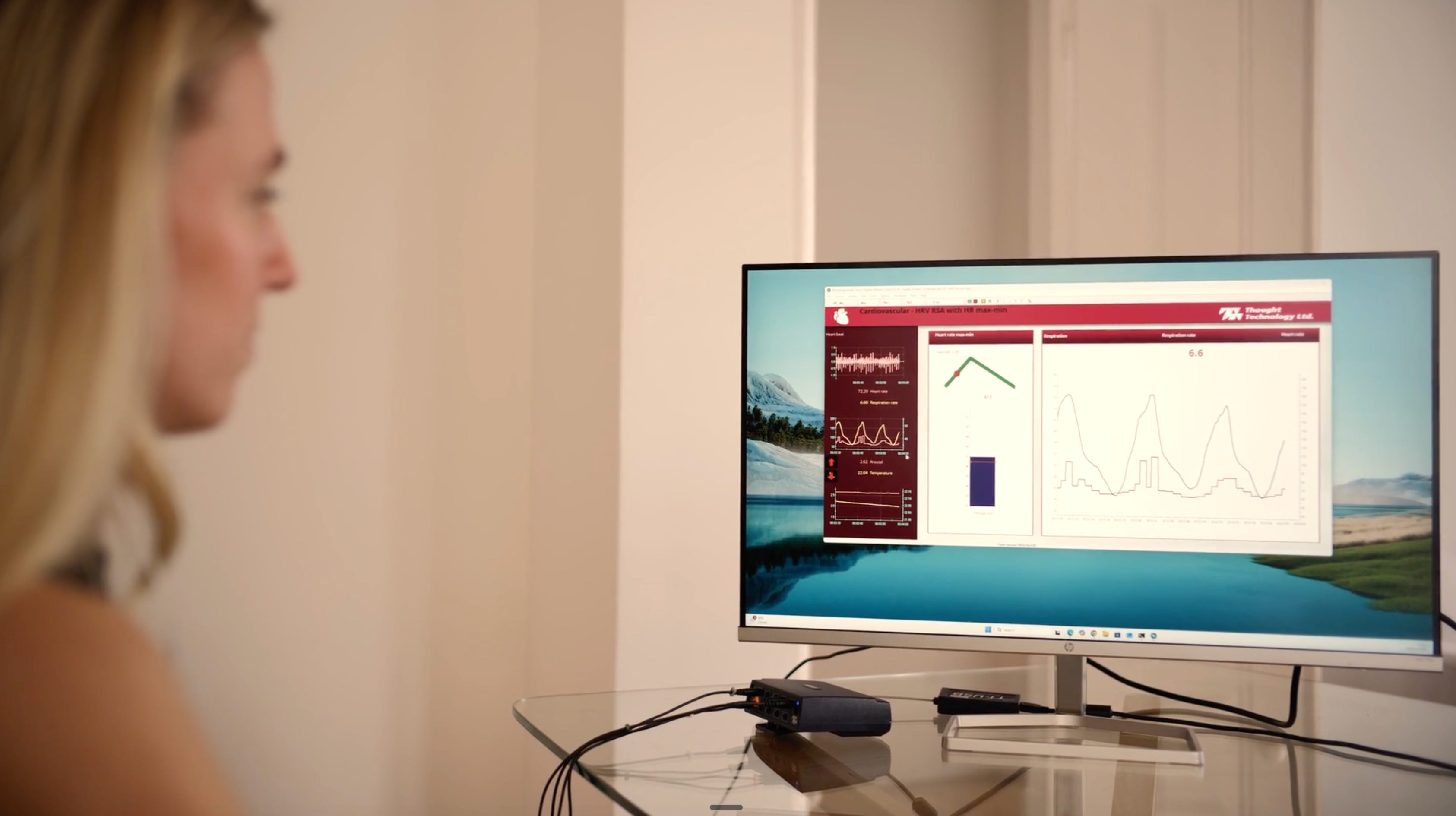
A client sat down with me a few weeks ago who’d read all of this already. She knew the theory better than most. Then I put a sensor on her and brought up two lines on the screen. One was her breath. One was her heart rate. And as she breathed, the two lines moved together, climbing on the inhale, falling on the exhale, in one slow wave.
She went quiet for a moment. Then she said, “I didn’t know it actually did that.”
She’d known it intuitively. Most people do, the second you say it out loud. But watching her own heart speed up and slow down with her own breath, in real time, was a different thing entirely. It stopped being a fact she’d read and became something she could see was true about her own body. That is the moment the training gets easier, every time.
Your heart is faster than you are
Your heart has its own pacemaker, a small patch of tissue called the sinoatrial node. Left completely alone, with no nerves feeding into it, it fires at around 100 to 110 beats a minute.1
Find your resting pulse right now.
Sit still for a minute first, then press the pads of your index and middle fingers, not your thumb, into the soft groove on the inside of your wrist, an inch or so below the base of your thumb.
The side of your neck, just beside your windpipe, works too.
Use light pressure.
Count the beats for thirty seconds and double the number, or count a full minute if the rhythm feels uneven.
A normal resting rate runs anywhere from 60 to 100, and most people land in the 60s or 70s.
That is below your heart’s own natural speed.
Something is holding it down.
That something is your vagus nerve. It is the brake. At rest it stays on, constantly, keeping your heart well below the rate it would run at on its own.
We know this from what happens when the brake gets removed. To transplant a heart, surgeons cut every nerve connection to it, including the autonomic ones. Once that heart is beating again it runs much faster than a normal resting rate, and the gentle beat-to-beat variability you’d see in a healthy heart goes flat.2 With the autonomic nerves cut, the brake is gone, and the heart just runs.
Your heart would gallop near 100 on its own. That calm resting pulse you’re rather proud of is the vagus holding it down, all day long.
You’ve just never felt the brake working.
The brake breathes with you
Now come back to those two waves. The reason your heart rate climbs when you inhale and drops when you exhale is that vagal brake easing off and then returning, breath by breath.
On the inhale, the brake lifts a little, and the heart quickens. On the exhale, the brake returns, and it slows. This rise and fall has a name, respiratory sinus arrhythmia, and it’s the clearest sign there is that your vagus nerve is working.
Which means every exhale you’ve ever taken was you pressing that brake. You’ve been doing it your whole life without once thinking about it.
Where resonance comes in
There’s a particular pace where this stops being subtle. Slow your breathing to somewhere between 4.5 8or eve and 6.5 breaths a minute and a second system joins in: the baroreflex, the loop that manages your blood pressure. It runs on its own rhythm, and when your breath happens to match that rhythm, often around 5.5 breaths a minute, the two lock together.3
When they do, the swing in your heart rate grows several times bigger than at rest, four to ten times larger in some measurements.4 The researchers Shaffer and Meehan describe it as striking a bell that keeps on resonating.5 That matched pace is your resonance frequency, the rate where the brake works at full strength.
I recorded this on myself, so you can watch it instead of taking my word for it.
In the first clip I’m breathing fast, more than fifteen breaths a minute, the way most of us breathe through a busy day. Green is my breath, red is my heart rate. The red line moves a little, but it stays up above 70 the whole time. The brake barely gets a chance to work.
In the second clip I’m breathing at my resonance frequency. Same two lines, a few minutes later. Now watch the red line on every exhale. It falls, all the way down to 62, and climbs back on the inhale, in one slow wide wave. The only thing that changed is the pace of my breath
That dip on the exhale is the brake, and you are watching it happen in real time. At the right pace it swings wider and pulls the heart rate down further than you would expect.
What twenty minutes feels like
I have clients breathe at their resonance frequency for around twenty minutes. I find their resonance frequency breath rate in the office, but their are apps that can also help you find the rate (Optimal HRV) if you use them with a heart rate sensor like the Polar H10.
What happens after twenty minutes is hard to draw on a chart.
Calm, yes, and underneath the calm a kind of clarity and focus that wasn’t there before. The instruction I give is to stop at the end, sit, and feel it. Don’t reach for your phone. Look inward and notice what regulated actually feels like from the inside.
Do this for around twenty minutes a day and you’re giving the parasympathetic side a proper workout. Dr Andrew Han, whose excellent Labfront HRV course foes through most of the physiology in this letter, describes a strong resting vagal tone as a reserve.
Train it and you build the capacity to settle yourself when you need it.
The brake gets stronger the more you use it, and after enough practice your body starts reaching for it on its own, when a hard moment lands or when you need to drop into focus.
That is the whole point of the practice. Resonance frequency breathing trains one thing: feeling regulation from the inside, often enough that your body learns its own way back.
The number on the screen is just the door in. Once the feeling is familiar, you can find your way back to it on moments of stress or in the ten minutes before you fall asleep, no sensor needed.
Something to try this week
You don’t need a screen for this one. You can feel the brake yourself.
Get your heart rate up first. Thirty to sixty seconds of jumping jacks or stairs, enough that you can feel your pulse pick up. Then stop. Put a hand on your belly and chest. Start breathing slowly and make the exhale longer than the inhale. Six counts out, four counts in, or whatever feels unforced.
Breathe from the belly instead of the chest if you can, letting the lower ribs widen and the abdomen move out as you inhale, with your shoulders staying soft. If that feels impossible, don’t worry about it. Most of us are conditioned chest breathers and it takes time to undo. Erik Peper, a professor who has spent decades on this, has a clear guide to diaphragmatic breathing on his blog if you want to learn it properly.
Now pay attention to the next handful of breaths. Your heart will start to settle within seconds, far too fast to be rest. That settling is you leaning on the brake, by hand.
That feeling you just found is the thing we train.
One careful note before you do it. Slow breathing suits most people, but not everyone. If you ever feel faint while breathing slowly, breathe a little more shallowly. And if you overbreathe to manage a medical condition, sit this experiment out.6
One last thing.
These letters aren’t homework. You’ve probably got a ring or a watch already counting your heart for you, and you don’t need to add one more thing to measure and track, you’ve got plenty of that already.
I write them so you can feel the thing for yourself and trust that it’s there. Seeing it once on a screen, or feeling your pulse settle under your own fingers, is enough to know the brake is real and that you can find your way back to it.
If this letter showed you something about your own body, forward it to one person who’d want to feel it too. That one forward does more for this letter than anything else.
Next week, how I found my own resonance frequency, and how it keeps changing. See you then.
Klabunde RE. *Cardiovascular Physiology Concepts*. The sinoatrial node’s intrinsic firing rate, free of autonomic input, is roughly 100 to 110 bpm. cvphysiology.com.
Han A. *Fundamental HRV Physiology and Frequency Domain*, Labfront HRV course. A transplanted (denervated) heart beats faster than a normal resting rate and loses its beat-to-beat variability; a strong resting vagal tone functions as a reserve. https://www.labfront.com/course-video/hrv-physiology-frequency-domain
Vaschillo E, Lehrer P, Rishe N, Konstantinov M. Heart rate variability biofeedback as a method for assessing baroreflex function: a preliminary study of resonance in the cardiovascular system. *Appl Psychophysiol Biofeedback*. 2002;27(1):1-27. doi:10.1023/A:1014587304314
Lehrer PM, Vaschillo E, Vaschillo B. Resonant frequency biofeedback training to increase cardiac variability: rationale and manual for training. *Appl Psychophysiol Biofeedback*. 2000;25(3):177-191. doi:10.1023/A:1009554825745
Shaffer F, Meehan ZM. A practical guide to resonance frequency assessment for heart rate variability biofeedback. *Front Neurosci*. 2020;14:570400. doi:10.3389/fnins.2020.570400
Khazan I. *Clinical Handbook of Biofeedback*. Wiley. Slow-paced breathing cautions and contraindications, including overbreathing signs and metabolic-compensation cases.