


Series: Resonance Frequency breathing, Letter 1 of 4.
Last week I told you about the father who put his daughter to sleep.
He had come to me to get better at his sport. He left with a way of breathing that settled a child whose broken sleep had bent his whole household out of shape. I named it that day, resonance frequency breathing, and then left it sitting there without explaining it.
So let me explain it.
Over the next four letters I want to take resonance frequency breathing apart and show you the physiology underneath it. Something specific happens inside your body when you breathe this way, and once you can see it, it stops feeling like magic and starts feeling like a mechanism you can use.
Today, the first piece. What is actually happening in there.
Why slow breathing changes the body
Start with the muscle.
Slow breathing is diaphragmatic breathing. The diaphragm drops, the belly moves, the lower lungs fill where most of the blood flow sits. Breathe fast and high instead and you recruit the accessory muscles in the neck and chest, the ones built for emergencies, not for every minute of a working day. Low and slow uses the right engine. Deep and fast is close to the worst thing you can do, because it pairs maximum effort with minimum efficiency.1
Then the chemistry. What drives the urge to breathe is not a shortage of oxygen. It is carbon dioxide. CO₂ is the master regulator, and when you overbreathe you blow off too much of it, blood pH rises, and hemoglobin holds on to its oxygen instead of handing it to the tissue. You breathe more and your cells get less.2
Then the heart. Every time you inhale, your heart speeds up. Every time you exhale, it slows down. That rhythm is respiratory sinus arrhythmia, and it runs on the vagus nerve, the body’s brake on the heart. A slow exhale lengthens the brake.3 This is the coupling my clients watch on the screen.
Then resonance. Your heart rate and blood pressure run on two closed loops that feed into each other, and at one breathing rate, somewhere between 4.5 and 6.5 breaths a minute, the loops line up. When they do, the swing in your heart rate grows four to ten times larger than at rest.4
This is the substrate underneath everything I train. It has to be made visible before it can be trained.
The three numbers I built my practice around
So I built a dashboard.
After reading the research, listening to every relevant episode of the HRV Podcast, hosted by Matt Bennett , and sitting in the rooms at this year’s AAPB conference, I chose three numbers to anchor my practice around. After three months with me, my clients read all three the way you read a familiar face.
RMSSD is beat-to-beat variability, the cleanest signal of the vagus nerve you can get from a quiet morning reading. It is your recovery branch showing its work. When RMSSD climbs, your brake is doing its job. It drops when you are under-slept, when you drank last night, when you are getting sick, when the week has been too much.
HRV-CV is the coefficient of variation across that reading, a longer way of saying how steady the signal is. Low and even means the system is settled. When it swings, something is loading you, and most people feel that before they can name it.
LF power is low-frequency power during a training session, the band that answers most directly to slow breathing and the baroreflex. When LF power lifts while you breathe at your resonance rate, the nervous system is doing the real work, the kind that turns into long-term gains.
Most of my clients already track some version of this. Oura, Whoop, Apple Watch, Garmin, all reading the same body. When I tell people what I do:
Them: “Oh, I have an Oura ring too”
Me: “Great, so you must know something about your RMSSD or HRV”.
And that is where the conversation ends. They have the number. Nobody ever told them what it means for them, or what to do with it. That gap, between having the data and knowing what to change, is what I built my work to close. It is what these letters are for.
My dashboard does not replace the ring. It is the in-session companion, the three numbers from structured biofeedback work set against the lifestyle data you already collect every day. Together they tell a fuller story than either alone.
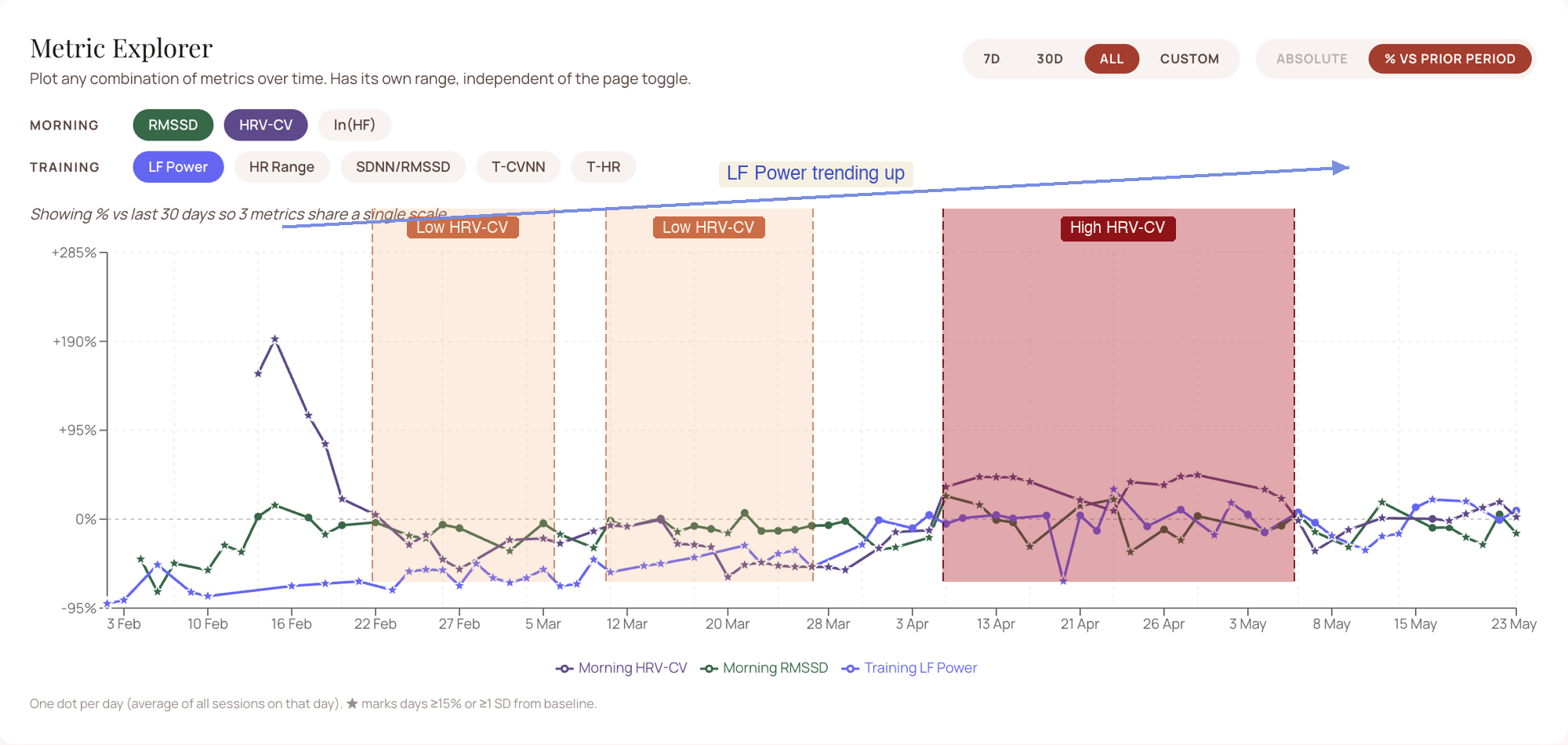
The image with this letter is one client’s four months (Sharing with consent). Mornings and training sessions, one dot per day, the three lines moving against each other. It is not a clean sweep, because no real body gives you one. We are human, and change takes time. What three months of your own data gives you, baseline and training both, is the ability to see when something shifts and to know which way you want it to go.
I marked three windows where the shift showed up.
A Low HRV-CV and stable RMSSD stretch in February and March, where the morning signal went quiet and steady.
A High HRV-CV and dropping RMSSD window through April and May.
A slowly upward trending LF throughout the last 3 months.
Higher RMSSD, lower HRV-CV during baseline and higher LF power during the breathing work. That is the direction we train toward. Not on any single day, and not in a straight line. Over months, as a pattern.
Here is the part that surprises people. The numbers are not even where we start.
Before the first reading, the work is interoception, learning to become aware of your own internal state, your breath, your tension, the pace of your own thinking, well enough to notice it without a screen. In practice it starts small. Thirty seconds before a morning reading, noticing where your breath sits and what your jaw is doing. Catching your shoulders halfway to your ears in the middle of an ordinary email. We build that first, and the numbers come after, to confirm what your body is already starting to tell you.
The metric was never the most important thing. Knowing yourself is.
Where I learned this
I came to this through my own training first. I’m trained in biofeedback and hold a Master of Science in Applied Neuroscience from King’s College London, and during it I ran a three-month study combining HEG neurofeedback, gyrotonic movement, and resonance frequency breathing. The statistics came back muted. The people came back changed. That gap is most of why I do this work the way I do.
The rest I learned from keeping up to date with people who have been at it far longer, and you should have their names in case you want to follow the trail.
Dr. Jay Wiles, at Ohm Health, puts hard numbers on the page: ”during active sessions, heart rate variability increases 100 to 300 percent, though these are transient state changes; longer-term trait adaptations of 10 to 25 percent emerge after 6 to 8 weeks of consistent practice.”5
Dr. Christine Sanchez frames ”low and slow diaphragmatic breathing” as a trained mental skill rather than a wellness practice.6 Dr. Stephen Sideroff, at UCLA, has spent forty years calling autonomic regulation the substrate underneath every other resilience practice.7 He also wrote an excellent book that go over the 9 Pillars of Resilience.
What the field is building next
This space already holds a lot of good technology, and at this year’s AAPB I got to put my hands on what is coming next.
The one I keep thinking about is the Ohm Resonance Lamp. I tried it at the conference and loved it. It is a screenless biofeedback loop in hand-blown borosilicate glass, built by Ohm Health, and it guides you into your resonance window with light, sound, and a faint vibration, no numbers to stare at. Dr. Jay Wiles, the one I quoted, is the scientific lead behind it. It ships in August 2026, and I cannot wait to get my own.
What the dashboard shows me
This is where the research stops being research.
The first time someone sees their own physiology move in real time, something shifts in the room. One client, training with me for a few months, put it this way. The biggest change has been to their breath, and *”having the biofeedback really helps you keep focused, keep motivated, as you see your progress and how your different lifestyle patterns impact your readings every day.”*
What I watch for is a single moment, and across roughly 150+ sessions it has been the same one every time. The diaphragm rises and falls on the screen, and heart rate and breath rate slide into the same rhythm, climbing together on the inhale, settling together on the exhale.
That is when it clicks. That is when a person stops taking my word that breath and heart are connected and starts seeing it. That is the translation I am building my practice around.
Right now I do this by hand. Before a session I read what a client brings from their wearable, last night’s sleep, today’s training load, the afternoon that went sideways, and I shape the live work around it. I’m building the integration. Not so that I can become another wearable, but because I can use the wearable data to better inform my client. The next step is wiring it into the dashboard itself.
Why his daughter fell asleep
I owe you the end of that story.
I cannot tell you exactly why his breathing put his daughter to sleep. I was not in the room, and even if I had been, some of this still sits past the edge of what I can measure.
But I have a strong guess, and it is something you already know from your own life. We regulate each other. You walk into a room and catch the mood before a word is said. You sit beside someone calm and your own shoulders drop. You do not need a study to know we feed off each other’s energy.
Researchers call it co-regulation. When two people focus on their breath near each other, their autonomic systems begin to synchronize, heart rate, heart rate variability, and skin conductance all moving closer together than they otherwise would.8And the direction matters.
A regulated adult’s nervous system carries into a child’s: in mother and infant pairs, the mother’s heart rate variability tracks the infant’s, and in the most synchronized pairs it reaches all the way into the infant’s brain activity.9 It is not only parents and children. The same synchrony shows up between close friends and partners in ordinary supportive conversation.10
So here is what I think happened that night. He sat beside his daughter and ran the breathing he had trained for months, until it was reflexive. His system slowed. Hers, lying next to his, had something steady to borrow.
The brake he built for himself reached her too.
That is the piece of this work I find hardest to put into a number, and the piece I believe in most.
What’s coming
This is the first of four letters on resonance frequency breathing.
Next Sunday is the how your heart and your breath lock to create coherence. Two more letters after that close the resonance arc, and then the deep dive moves to the next pillar.
Something to try this week. Breathe in for about four seconds and out for about six, for five minutes, and notice what settles. Your exact resonance rate has to be measured, which you can do with me or with a good app like Optimal HRV, but a six-second exhale is a fair approximation, long enough to feel the brake lengthen.11
If this letter is for you, forward it to one person who would read it on a Sunday morning.
See you next week.
Khazan, I. Z. (2013). *The Clinical Handbook of Biofeedback: A Step-by-Step Guide for Training and Practice with Mindfulness.* Wiley-Blackwell. / Peper, E., & Gibney, K. H. (2006). *Muscle Biofeedback at the Computer.* Biofeedback Foundation of Europe. Khazan, I. Z. (2013). *The Clinical Handbook of Biofeedback: A Step-by-Step Guide for Training and Practice with Mindfulness.* Wiley-Blackwell. / Peper, E., & Gibney, K. H. (2006). *Muscle Biofeedback at the Computer.* Biofeedback Foundation of Europe.
Khazan, I. Z. (2013). *The Clinical Handbook of Biofeedback: A Step-by-Step Guide for Training and Practice with Mindfulness.* Wiley-Blackwell. / Peper, E., & Gibney, K. H. (2006). *Muscle Biofeedback at the Computer.* Biofeedback Foundation of Europe
Gevirtz, R. N., Lehrer, P. M., & Schwartz, M. S. (2016). Cardiorespiratory biofeedback. In M. S. Schwartz & F. Andrasik (Eds.), *Biofeedback: A Practitioner’s Guide* (4th ed.). The Guilford Press. https://www.researchgate.net/publication/316347929_Biofeedback_A_Practitioner’s_Guide_Fourth_Edition_edited_by_M_Schwartz_F_Andrasik_2016_New_York_NY_The_Guilford_Press_xx_764_pp_11500_hardcover_6000_paperback
Shaffer, F., & Meehan, Z. M. (2020). A practical guide to resonance frequency assessment for heart rate variability biofeedback. *Frontiers in Neuroscience, 14,* 570400. https://www.frontiersin.org/journals/neuroscience/articles/10.3389/fnins.2020.570400/full
Wiles, J. (2025). *Ben Greenfield Life* podcast and Ohm Health technical materials.
Sanchez, C. (2024). via Stoic Conditioning.
Sideroff, S. (2022). Interview with Dr. Kara Fitzgerald.
Balconi, M., Allegretta, R. A., & Angioletti, L. (2023). Autonomic synchrony induced by hyperscanning interoception during interpersonal synchronization tasks. *Frontiers in Human Neuroscience, 17,* 1200750. https://www.frontiersin.org/journals/human-neuroscience/articles/10.3389/fnhum.2023.1200750/full
Brandes-Aitken, A., Hume, A., Braren, S., Werchan, D., Zhang, M., & Brito, N. H. (2024). Maternal heart rate variability at 3-months postpartum is associated with maternal mental health and infant neurophysiology. *Scientific Reports, 14*(1), 18766. https://pubmed.ncbi.nlm.nih.gov/39138268/
DiGiovanni, A. M., Peters, B. J., Tudder, A., Gresham, A. M., & Bolger, N. (2024). Physiological synchrony in supportive discussions: An examination of co-rumination, relationship type, and heterogeneity. *Psychophysiology, 61*(7), e14554. https://doi.org/10.1111/psyp.14554
Lehrer, P. M., Vaschillo, E., & Vaschillo, B. (2000). Resonant frequency biofeedback training to increase cardiac variability: Rationale and manual for training. Applied Psychophysiology and Biofeedback, 25(3), 177–191. https://doi.org/10.1023/a:1009554825745
I love reading about co-regulation because that's what I do in my somatic healing yoga sessions. The story of the dad putting her daughter to sleep is so lovely, the unspoken safety is so contagious! I appreciate how interoception is emphasized, as I also believe that is the starting point.