


The night his daughter fell asleep
He’d been sitting next to her bed for the better part of an hour. Her sleep had been broken for months. Everything he’d tried
had stalled, and the household had started to bend around it.
He started breathing the way he’d been trained to breathe. Slow, paced, the rhythm he’d been practicing for his sport. He was
doing it for himself, because he was tired and it was the thing his body now reached for when things got hard.
Ten minutes passed. He looked over at her and she was fast asleep. He couldn’t believe it could have been the breathing, so he
tried it again the following evening. It worked again. He told me later it was the thing from the whole study that changed his
life.
He came to me to play his sport better. He left with a tool for parenting a child who couldn’t fall asleep.
Why I came to biofeedback
I came to this work because nervous system regulation resonated with me. I spent a good part of my life struggling with
dysregulation due to various life factors we all face, so when I heard about a method that allowed me to see those patterns, for what they are and bring them into a more regulated state, how could I look away?
I’m Lucie Schnitzer. I hold a MSc. in Applied Neuroscience from King’s College London, and I work as a Biofeedback Practitioner in a health and wellness context.
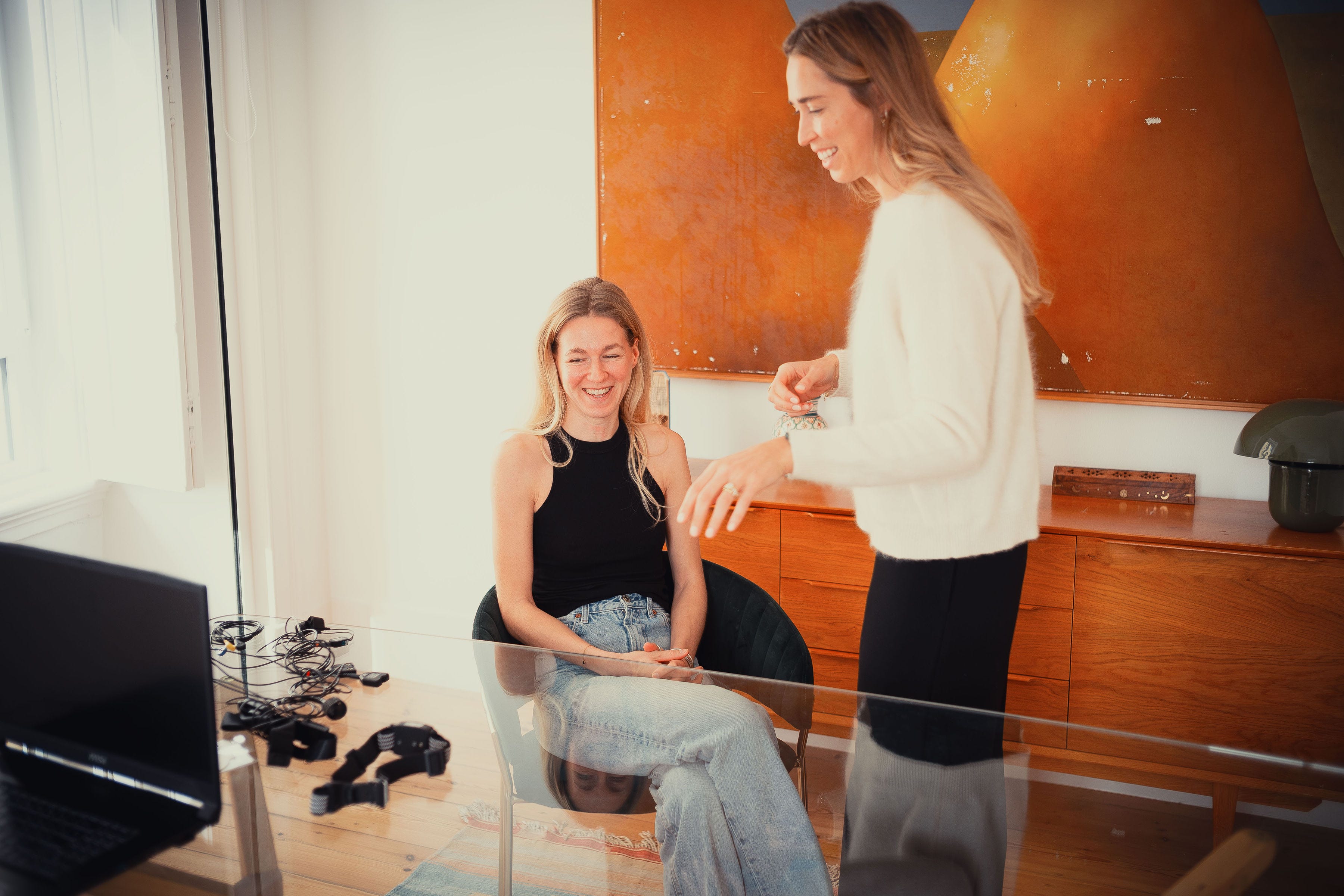
My week is spent reading nervous systems through multi-channel biofeedback, six physiological signals at once, watched across structured stress and relaxation assessments.
This letter is where I write about biofeedback as a stress-management tool, what the data shows, what it means, and what to do about it.
The study that pointed somewhere unexpected
During my MSc, I ran a three-month research study combining HEG neurofeedback with gyrotonic movement and resonance frequency breathing.
The sample was small. The statistical results came back muted. By any conventional read, the study had little to publish.
Calling it a “publishable” study is a stretch. It was the first study I ever ran, and it came with its faults.
The participant reports came back as something else.
People kept finding the skill in places the protocol hadn’t reached. That gap, between what the study was designed to measure and what the people were actually living, is where the Default Resilient Method came from.
The study taught me to listen for the transfer, to ask where the skill went after we’d stopped looking, and to read the participant’s life as data the protocol
couldn’t see. I carry that into every session now.
People came in for one thing. The skill went somewhere else.
The man whose daughter fell asleep had joined the study to sharpen focus and processing speed for his sport. He’s a judoka, one who participates in judo, and a judo coach for young children. Within a few months he was using resonance frequency breathing between matches and mid-round on the mat.
He went into the zone faster. He recovered between rounds without the strain he used to feel. He stayed steady in matches that used to wear him down emotionally. All of that tracked with what he’d come for.
The daughter was the surprise.
A runner who’d never completed an 11K with quiet thighs did the run. After a few months of training, the thing that had stopped her was gone. Her training mechanics stayed the same.
What changed was how her nervous system was holding the body.
A participant recovering from surgery used the activation and deactivation skills she’d built in our sessions during her physiotherapy. She started moving her attention away from the pain when the work got hard.
Her recovery clocked at the faster end of the range her surgeon had given her.
One participant used the breathing before a difficult conversation with their partner and credited it with keeping the conversation in a place that would otherwise have collapsed.
One reported the tinnitus getting quieter on training days, sometimes absent for longer stretches.
People came in for performance. The skill went into sleep, into parenting, into recovery, into the corners of life nobody had thought they were training for.
Why the skill transfers
The thing being trained is the autonomic nervous system itself. Once the body has a way of moving between activation and recovery on demand, that capacity is portable.
It goes wherever the body goes.
That’s why a breathing pattern trained for performance during a judo match settles a child at bedtime. The system underneath is the same system.
The skill works in whatever room the body walks into.
Why the method is built as exploratory
Every assessment opens with goals. The goals are the start, and the work travels past them.
The data shows you the pattern. The practice trains the skill. Once the skill is in the body, life shows you where it goes.
I work with six physiological signals across the autonomic nervous system. The Default Resiliency Index is a composite that summarizes where someone is sitting on the day.
Underneath it, the per-system breakdown is what we actually train against. Since
I started working with clients last November, I’ve run around 30 stress and recovery assessments, and the consistency still
surprises me. Most clients fall within one of four patterns: Settled, Resilient, Shutdown, Activated.
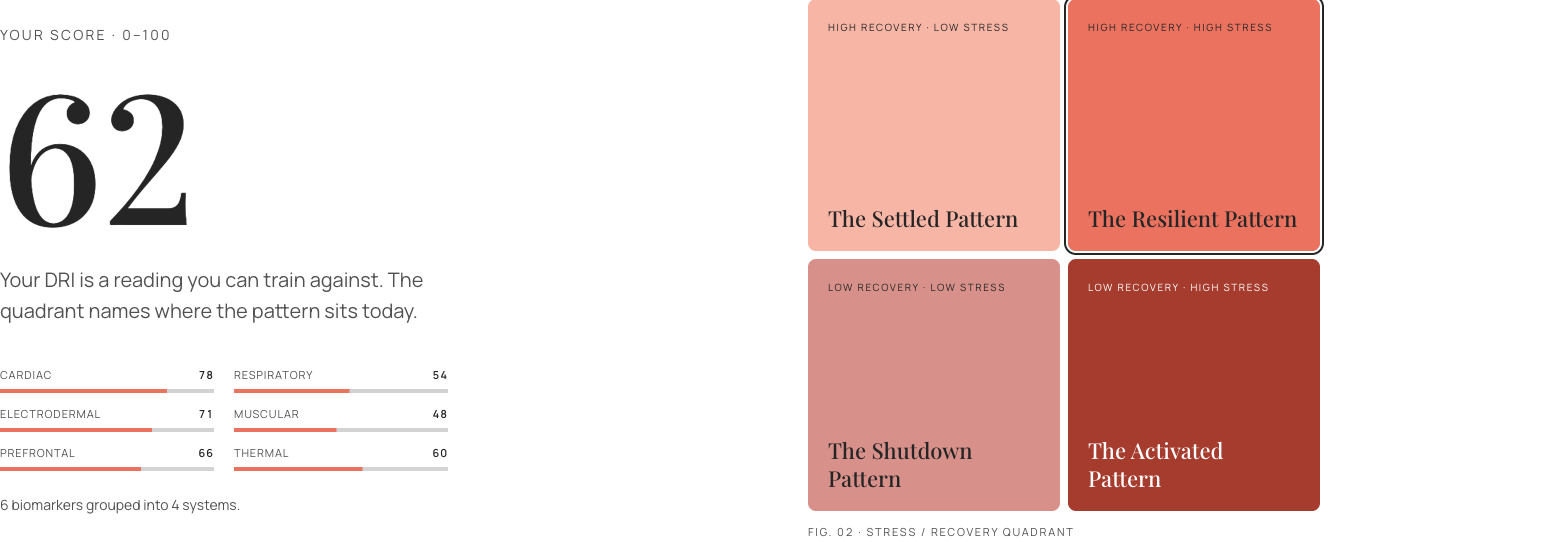
The arc of the work is reactivity, recovery, integration. We measure how the system fires, how it comes back down, and how it carries the skill into the rest of the week.
The integration piece resists scripting in advance, because the participant’s life writes that chapter.
A healthy default resilient state has three pieces:
Appropriate reactivity when a stressor arrives.
Complete recovery when it ends.
Freedom of movement between activation and rest. All three get built through practice.
What you’ll get on Sundays
One essay per week. Every Sunday morning, around 1,500 words. One topic, one framework, one practice.
Some weeks the essay is a method piece. How resonance frequency breathing actually works. How HRV comes into play. What the sEMG sensor picks up. Why prefrontal blood flow matters. How the Default Resiliency Index is scored. These weeks earn their weight in research and mechanism.
Other weeks it’s a case. A composite of clients I’ve worked with, the physiology of a specific pattern, the moment in the assessment when someone sees their own data for the first time and the pattern becomes visible.
Every issue ends with something you can try. Something to notice. A small practice. A reframe you can carry into Monday.
Where this is going
What I will say is this.
The most useful things I learned in that study came from the participants telling me where the skill had shown up that week, beyond anything the instruments recorded. That’s still how the work moves forward, week by week, client by client, story by story. The letter is built the same way.
If this letter is for you, forward it to one other person who’d read it on a Sunday morning. That one forward matters more to me than anything else right now.
See you next week.