


Series: Resonance frequency breathing, letter 3 of 4
Before getting into biofeedback and exploring different “breath work” techniques to “regulate my nervous system”, I didn’t know what was working. I didn’t know what I was training for and I certainly didn’t stick to a consistent breathing practice.
I use quotation marks because there truly only is 1 breath rate that regulates your nervous system I.e. has an impact on your HRV. And this sits on 60+ years of research. Read issue 2 if you want to know what that means. I’ll share some of the research below.
When I finally learned this breath rate and measured it, the concept of regulating through breathing made sense to me. I started using a pace built for me instead of a number built for everyone.
The last two letters showed you the machinery: the vagal brake slowing your heart on every exhale, and the chemistry underneath it. I kept pointing at one rate where all of this gets bigger and never told you how to find your own. So this week, that. How you find the rate that is actually yours, with the tech or without it.
Why there is a rate that is yours
Go back to the two waves from last week. Your heart speeds up on the inhale and slows on the exhale. That is one rhythm. Underneath it runs a second one, the baroreflex, the loop that manages your blood pressure, and it keeps its own slow timing.
At most breathing speeds those two rhythms are out of step. Slow your breath down, though, and there is a point where they fall into the same wave. Your breathing rhythm and your blood-pressure rhythm meet, line up, and start pushing the heart the same way at the same moment. That is resonance. It is what happens when you push a swing in time with its arc instead of against it.
When they line up, the swing in your heart rate grows. The energy in the low-frequency band of your heart rhythm more than doubles, and the wave moves into the slow band where the real training happens.1 This is the thing my clients and I watch on the screen, heart and breath climbing and falling together in one wide line.
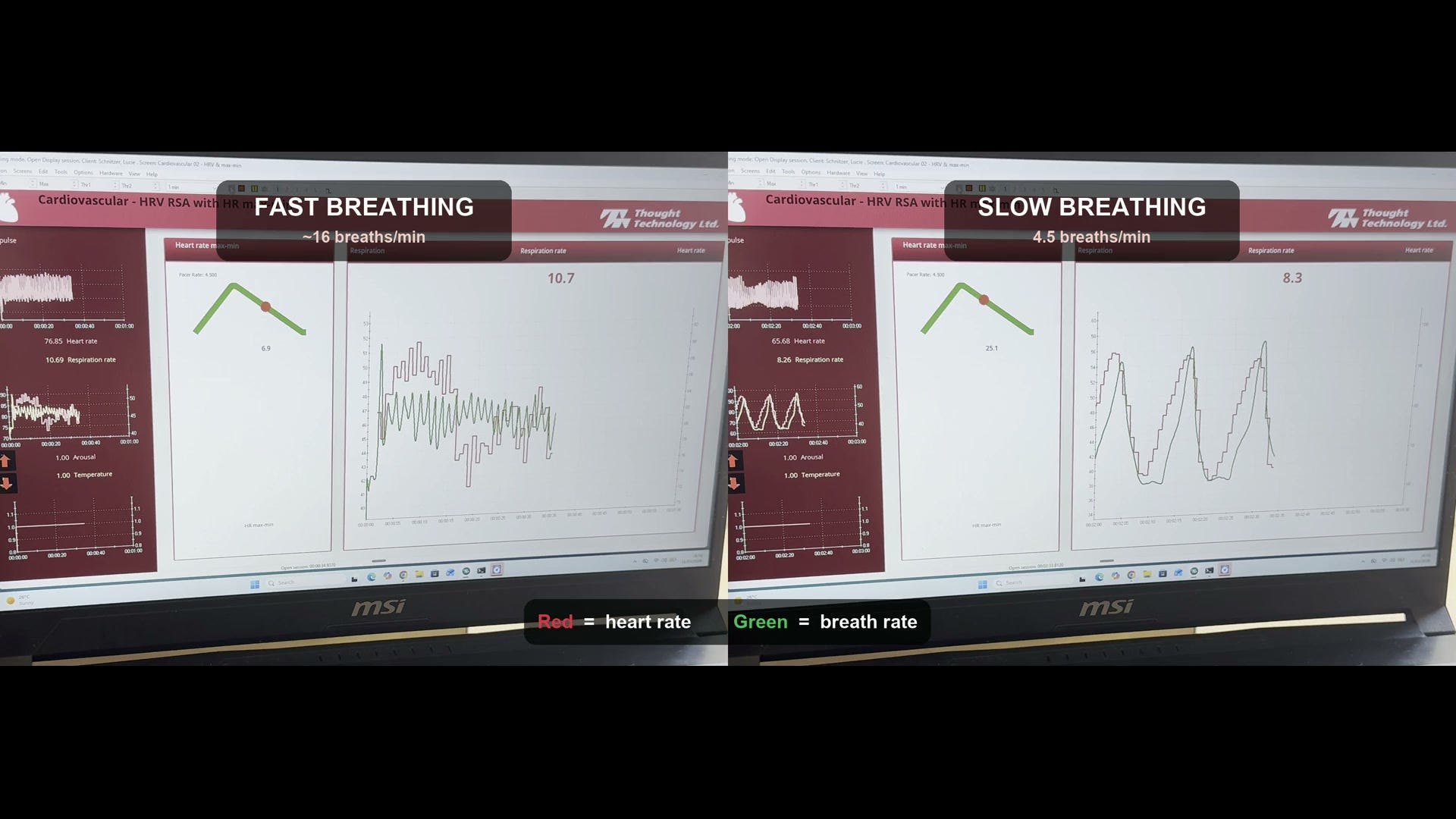
This is me on the sensors. On the left I’m breathing fast, about sixteen a minute. On the right I’ve slowed to four and a half. Red is my heart rate, green is my breath. Watch the right side. As the breath slows, the heart-rate wave opens up into those long, wide swings. That is the alignment, happening live, on my own body.
Here is the part that matters for finding your number. That meeting point is not the same for everyone. In adults it lands somewhere between 4.5 and 6.5 breaths a minute, averaging around five and a half.2 It is set mostly by your blood volume, which is why taller people and men tend to sit at the slower end. Your body already picked the rate. You just have to find where it is.
How to find yours, with the tech
The cleanest way is to let an algorithm watch your heart while you breathe through a range of rates, and mark the one where your heart-rate swing is biggest. That is the whole method, paced breathing stepped down slowly while something measures where the wave peaks.3
The app I recommend for this is Optimal HRV. It runs the resonance assessment and gives you your number. It reads your heart through a Bluetooth sensor, so you’ll want a chest strap like the Polar H10 (can usually find a cheaper version on amazon) for a clean beat-to-beat signal. I would run that every few weeks as you adapt to the breathing as the first time you take it, it probably won’t be the one, although it will be close.
If you’d rather skip screens, the Ohm Resonance Lamp walks you into your resonance window with light, sound, and a faint vibration, reading your signals and nudging your cadence until you settle there rather than handing you a number on a dial. I wrote about it in letter two. It ships in August.
How to find yours, without the tech
You don’t need any of it. You can get most of the way with a pacer, a notebook, and about a week of attention.
Start with the breathing itself, because the rate only works if the mechanics are right.
This is diaphragmatic breathing, driven from the belly rather than the high chest.
As you breathe in, your belly should rise and your lower ribs widen, with your shoulders staying soft. Most of us are conditioned chest breathers, so if that feels awkward or close to impossible at first, you’re in good company. Put a hand flat on your abdomen and, for a few breaths, exaggerate it, pushing your belly out into your hand on the inhale and letting it fall on the exhale. Do that a handful of times and the pattern starts to come back. Erik Peper has a clear guide if you want to learn it properly.4
For the pacer, I like Allos. It’s free, you set the inhale and exhale to whatever you want, and you can play calming music over the top while it paces you. The pace is simple, breathe in for about four counts and out for about six, a forty-sixty split, and slow it down or speed it up to move between rates. The exact ratio barely matters at resonance, so don’t agonise over it, however we know that extending the exhale is what keeps the vagus activated.5
In my office, with the sensors, we’d find your rate in one sitting, after we’ve learned the belly breathing. Without the tech, give it a week, one rate a day, working from the top of the range down to the bottom. Each day:
Breathe easily for a full five minutes first, to settle.
Then take that day’s rate from the table and hold it for ten minutes.
Keep it diaphragmatic the whole way.
|Rate (breaths/min)|Inhale | Exhale |
| 6.5 | 3.7 s | 5.5 s |
| 6.0 | 4.0 s | 6.0 s |
| 5.5 | 4.4 s | 6.5 s |
| 5.0 | 4.8 s | 7.2 s |
| 4.5 | 5.3 s | 8.0 s |
Each day, write down what that rate gave you. How much calm, how much focus, how much clarity, and how much of that heart-and-breath coupling you can feel as a slow, rocking rhythm once it arrives. While you breathe, pay attention to how it actually feels. You’re looking for the rate that comes the most naturally and still feels like training, the one your body settles into without going slack.
Hold onto one thing while you do it. The aim is to regulate. You’re after an awake, settled control, the kind you could carry into a hard conversation or the ten minutes before sleep, so if you find yourself drifting off, you’ve slipped past it into something softer. Stay alert and quiet at the same time.
One honest caveat. By hand you get close, and close is genuinely useful, but you don’t get exact. The precise method measures your heart and finds the peak, and feel alone can’t do that to the decimal. Settle anywhere in that range, though, and you are doing the work.
Once you have your number
When you know your rate, you practise it. This is where Elite HRV earns its place. It’s a good, free, pacer for training at your rate with a heart-rate sensor, so you can watch the alignment from the last two letters actually happen, heart and breath and blood pressure moving as one.
Seeing it is what makes you believe it about your own body, and believing it is what makes you come back to it.
Whether your number can change
People ask me if their rate is fixed for life. For a long time the field assumed it was mostly fixed, an individual constant set by your blood volume, which is why taller people and men tend to breathe slower at resonance. 6 The newer evidence complicates that. When one group re-tested people a week apart, the resonance rate had shifted in about two-thirds of them, and they tied the change to the spacing between the heartbeats rather than to anything dramatic.7 It is one small study of twenty-one people, and earlier work found the rate held steady, so hold it as an early lead and keep an eye on your own number.
The clearest case of a real shift is still a physiological one. Paul Lehrer describes a pregnant colleague whose rate slowed as her blood volume rose through pregnancy, then returned a few months after she gave birth.8 That is one person’s informal observation, not a study, so I hold it lightly. The honest takeaway sits between the two views. Your number is stable enough to train against, and worth re-checking now and then, especially in a season when your body is genuinely changing.
The number was never the point
I’ve spent this whole letter on a number, so let me undo that a little.
The rate is the door. What you’re really after is the feeling on the other side of it, the particular quiet that arrives when your systems line up. The first weeks of this work are about something quieter than the decimal. They’re about learning to feel your own settled state well enough that you can find your way back to it without a screen. The number gets you to the door. Knowing what regulated feels like from the inside is what lets you walk through it on a hard day with no sensor anywhere near you.
That is the skill. The rate is just how you find the room.
Something to try this week
Run day one today. Set a pacer to six breaths a minute, four in and six out, and breathe from the belly for ten minutes. Notice what it gives you, the calm, the focus, the clarity, the slow rocking coupling, and write a line about it. Tomorrow, drop to five and a half, and keep working down the table across the week. When you stop each day, don’t reach for your phone. Sit and feel what settled actually feels like, so your body remembers the way back.
One careful note, the same one as last week. Slow breathing suits most people and not everyone. If you feel faint, breathe a little more shallowly, and if you overbreathe to manage a medical condition, sit this one out.
If this letter helped you find your rate, forward it to one person who’d want to find theirs. That one forward does more for this letter than anything else.
Next week closes the resonance series, and then we move to the next pillar.
The number tells you where to breathe. Your body tells you when you’ve arrived.
See you next week.
Shaffer, R. & Venner, J. (2013). Heart Rate Variability Anatomy and Physiology. *Biofeedback*, 41(1), 13–25. DOI 10.5298/1081-5937-41.1.05. (At resonance, breathing more than doubles the low-frequency energy of the heart rhythm; HR and BP oscillations sit 180° out of phase and RSA is greatest.)
Shaffer & Venner (2013). Adult resonance frequency runs 4.5–6.5 breaths/min, set by baroreflex delay and blood volume; taller people and men sit at the slower end.
Thought Technology Ltd. (2010). *Basics of Heart Rate Variability Applied to Psychophysiology*, “Resonance frequency training,” p. 22. Method credited to Lehrer (Ch. 10, *Principles and Practice of Stress Management*): step the breathing rate down and track where the power-spectrum peak is maximized.
Peper, E. (2022). A breath of fresh air: breathing and posture to optimize health. *The Peper Perspective.* https://peperperspective.com/2022/04/03/a-breath-of-fresh-air-breathing-and-posture-to-optimize-health/
Meehan, Z. M., & Shaffer, F. (2024). Do Longer Exhalations Increase HRV During Slow-Paced Breathing? *Applied Psychophysiology and Biofeedback*, 49, 407–417. DOI 10.1007/s10484-024-09637-2. At 6 breaths/min, no significant HRV difference between 1:1 and 1:2 inhale:exhale ratios.
Shaffer & Venner (2013). Adult resonance frequency runs 4.5–6.5 breaths/min, set by baroreflex delay and blood volume; taller people and men sit at the slower end.
Capdevila, L., Parrado, E., Ramos-Castro, J., Zapata-Lamana, R., & Lalanza, J. F. (2021). Resonance frequency is not always stable over time and could be related to the inter-beat interval. *Scientific Reports*, 11, 8443. DOI 10.1038/s41598-021-87867-8. Test–retest, N = 21; the resonance rate shifted in about two-thirds of people across one week, linked to inter-beat interval (caffeine, sleep, and posture were controlled, not implicated). One small study, not yet replicated, and earlier work found the rate stable.
Lehrer, P. M. (2013). How Does Heart Rate Variability Biofeedback Work? Resonance, the Baroreflex, and Other Mechanisms. *Biofeedback*, 41(1), 26–31. DOI 10.5298/1081-5937-41.1.02. An explicitly anecdotal informal observation of one pregnant colleague, not a study.